

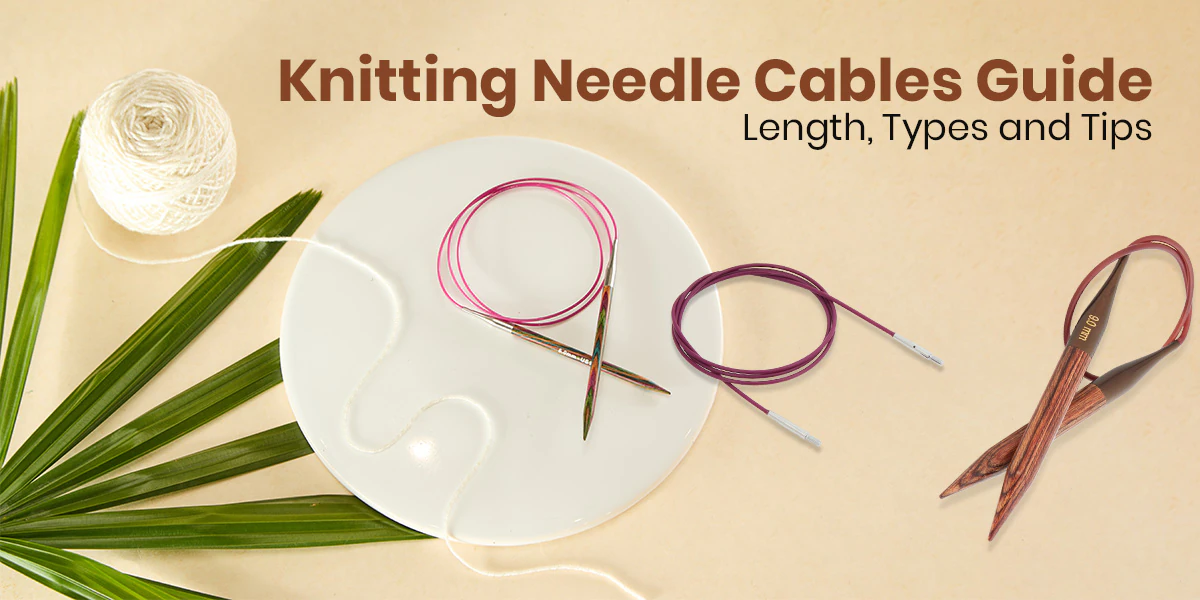
Ask any knitter to name the most important items in their kit and you will hear the same things every time. Great yarn. A good set of knitting needles. sharp tips, smooth surfaces. Maybe a stitch marker or two. But, Cables? They rarely make the list and that is a shame, because the cable is a tool behind some of the most satisfying knitting you will ever do.
If you are new to knitting, the word "cable" in this context has nothing to do with cable stitch patterns. We are talking about the flexible cord that connects the two needle tips on a circular knitting needle.
What a Cable Actually Does
The cable is the bridge between your two needle tips. When you knit in the round, whether it is a hat, a sweater, a pair of socks, or a seamless yoke, every stitch has to travel around that bridge. The cable holds all the stitches that are waiting for their turn. It is carrying the weight of your entire project while you work.
A stiff, kinked, or poorly made cable will fight you at every row. It will curl back on itself. It will resist lying flat. It will slow your rhythm down and make the whole process feel like a struggle. A well-made cable, on the other hand, practically disappears. The stitches glide. The cord lies relaxed in your lap. You stop noticing it because it is doing exactly what it should.
Also Read: Tips to Choose the Correct Cable Length for Knitting Projects
How Does Cables for Interchangeable Knitting Needles Change Everything
If you knit with a fixed circular knitting needle, the cable and the tips are one piece. You get one length, one material, done. But once you switch to interchangeable circular knitting needles, the cable becomes its own separate decision. And that is a very good thing.
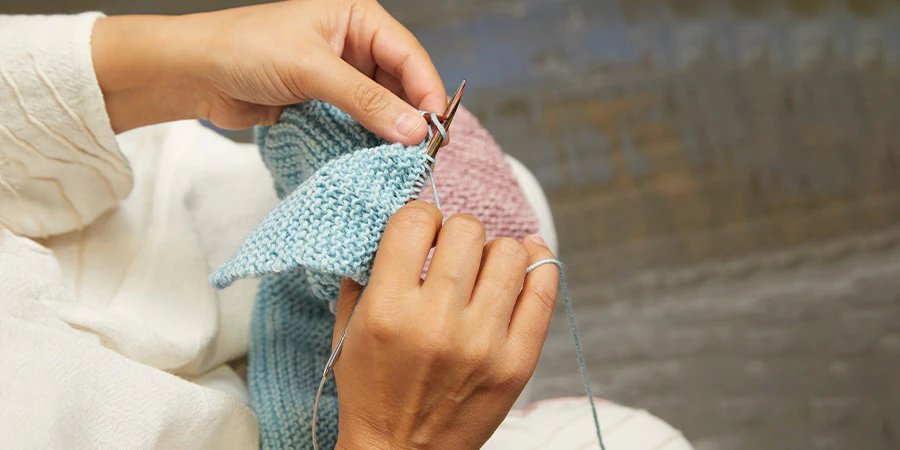
Interchangeable needle sets give you a collection of knitting needle tips that screw in and out of different cables. With a handful of tips and a range of cables, you can build almost any needle length you need for almost any project. One set can cover everything from a short 40 cm circle for socks, sleeves and hat crowns all the way up to a 150 cm cable for large shawls, blankets, or for magic loop knitting.
Choosing The Right Cable Length For Your Project
One of the most common frustrations new knitters face is trying to work on a cable that is the wrong length for the project. Too long and the stitches get stretched and awkward to move. Too short and everything feels cramped. Getting this right makes a real difference to how enjoyable your knitting session is.
40 cm: Hat crowns, cuffs, small sleeves. Best used with shorter interchangeable tips.
60 cm: Hats, yokes, sleeves. One of the most versatile everyday lengths in a knitter's kit.
80 cm: Adult sweater bodies, larger hats with many stitches, cowls and necklines.
100 cm: Large sweaters, magic loop for socks, two-at-a-time sleeves.
120-150 cm: Blankets, large shawls, big flat projects with hundreds of stitches.
One Important Note: with KnitPro interchangeable cables, the length stated is always the full tip-to-tip measurement once the needle tips are attached. A 60 cm finished needle uses a cable that is 35 cm long on its own. This is standard across the industry and worth knowing before you buy.
The Magic Loop Method and Why Cable Quality Matters Most Here
If you knit socks, mittens, or anything with a small circumference, you have probably come across the magic loop method. It involves folding a long cable in half and using that fold to work in the round on a small number of stitches. It is clever, it is efficient, and it means you do not need double-pointed needles for smaller projects.
For the magic loop technique to work well, your cable needs to be genuinely flexible. A stiff cable will not fold neatly and will keep pushing back against you.
Also Read: Choosing the Best Circular Knitting Needles for the Magic Loop
Cables as Stitch Holders
Here is a practical trick that experienced knitters have known for years. A cable with two end caps screwed on at both ends becomes a very effective stitch holder. Slip the stitches you want to park onto the cable, attach the end caps, and those stitches are going nowhere. If you have a few spare cables in your collection, this is a great second use for them between projects.
For New Knitters: Do Not Skip This Purchase
When you are setting up your first knitting kit, it is tempting to pick up a fixed circular needle for each project as you need it. That approach works fine at the start. But the moment you invest in an interchangeable circular knitting needle set, you will want a range of cable lengths alongside it. Starting with cables at 60 cm, 80 cm, and 100 cm will cover most beginner and intermediate projects without overcomplicating things.
KnitPro cables work across all their interchangeable needle collections. One cable is compatible with needle tips of Symfonie wood, Nova, Ginger, and more. You are not locked into one product line. One cable works with many tip combinations, and that flexibility is exactly what makes the interchangeable system worth investing in from the start.
For Experienced Knitters, It Might be Time to Refresh Your Cables
If you have a fixed cable, try the swivel cable. The 360-degree rotating connector prevents the twist that builds up naturally during long knitting sessions. If you have ever stopped mid-row to unwind a twisted cable, you will understand immediately what difference this makes to your flow.
The Underrated Hero of Your Knitting Bag
Without a good one, even the finest knitting needle tips will feel frustrating to work with. Browse KnitPro's full range of cables to find the length and type that fits your next project. KnitPro cables are available in standard lengths from 40 cm to 150 cm. Each cable comes with two end caps and a cable key, so you can park your work safely mid-project without losing a single stitch.


