

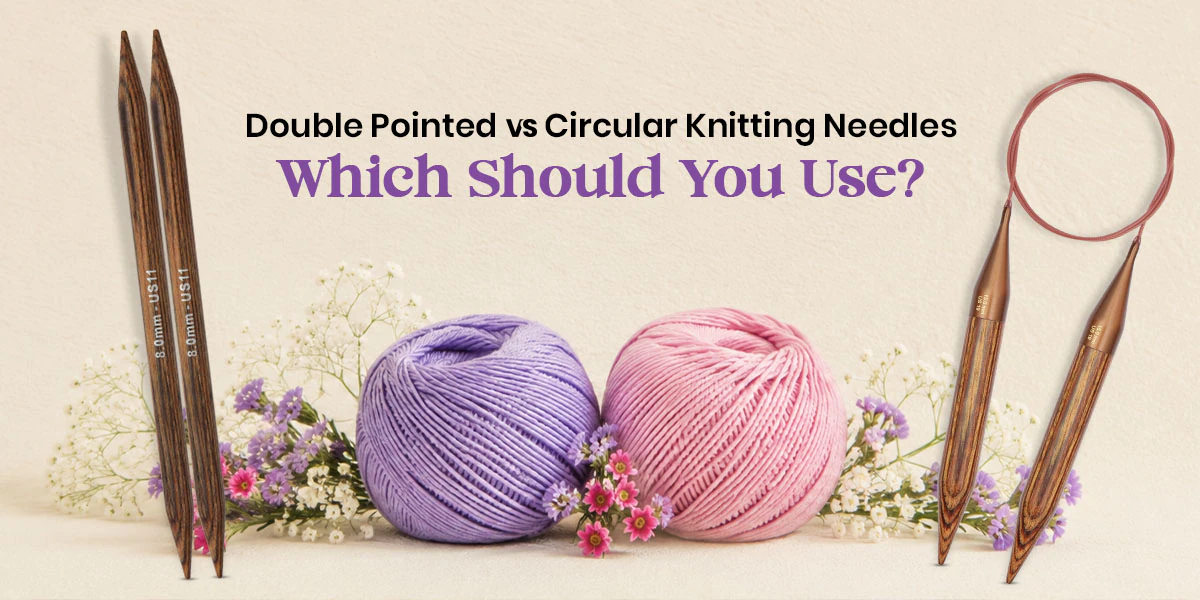
Knitting in the round is a skill every knitter needs. From socks to baby hats, sweater bodies, sleeves to home decor, the technique comes in handy. Double-pointed needles were the traditional way to make projects in the round; however, with the arrival of circular knitting needles, the options expanded. For knitters, the question came: double-pointed or circular knitting needles?
So, if you are debating too, in this blog, we’ll walk you through how to choose the right tool for knitting in the round. Double-pointed needles (DPNs) are best for small-circumference projects like socks and glove fingers. Circular needles handle larger projects like hats and sweaters. The magic loop technique on a long circular knitting needle is a good substitute for DPNs entirely for small items. However, it comes down to personal preference.
What Does 'Knitting in the Round' Mean?
Knitting in the round, also called circular knitting, means working in a continuous spiral or helix rather than turning your work at the end of each row. The result is seamless tubular fabric, and the right side of your work always faces you. This makes it ideal for garments and accessories that benefit from a clean finish with no sewing required.
Both double pointed knitting needles and circular knitting needles achieve this, just in different ways. Understanding how each works mechanically makes the choice much clearer.
Double Pointed Needles (DPNs): What They Are and How They Work
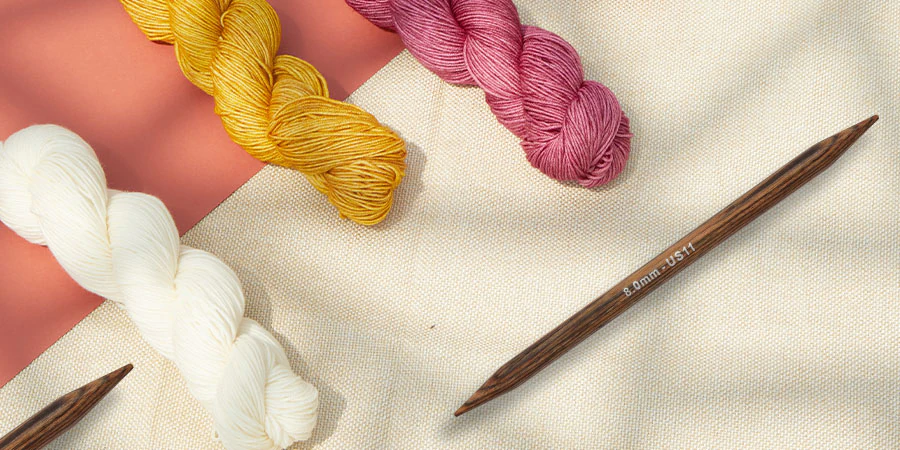
Double-pointed needles (DPNs) are short tips, typically 15 cm to 20 cm long, with a point at both ends. They are sold in sets of four or five. Your stitches are distributed across three or four needles, forming a triangle/square of fabric, while you use the spare needle to knit across each needle in turn. Once you finish one needle, it becomes the working needle for the next section.
Also Read: Knitting with DPNs: How to Cast on and Join in the Round
Best Projects for Double Pointed Needles
- Socks (leg, heel, and toe shaping)
- Gloves and mittens (including individual fingers)
- I-cord
- Small sleeves and cuffs
- Hat crowns when decreasing to a tight circumference
- Baby booties and small accessories
Advantages of Double-Pointed Needles
- No minimum circumference, work on very small tubes (as small as 12–15 stitches)
- Precise control on tight decreases, especially at sock toes and mitten tips
- No cables or connectors
- Compact and travel-friendly
Challenges of Double-Pointed Needles
- Managing multiple needles simultaneously can feel awkward for beginners
- Laddering (loose columns of stitches at needle joins) is common until the technique is refined
- Needles can slip out of work if not held carefully
- Not practical for large-circumference projects
Circular Knitting Needles: What They Are and How They Work
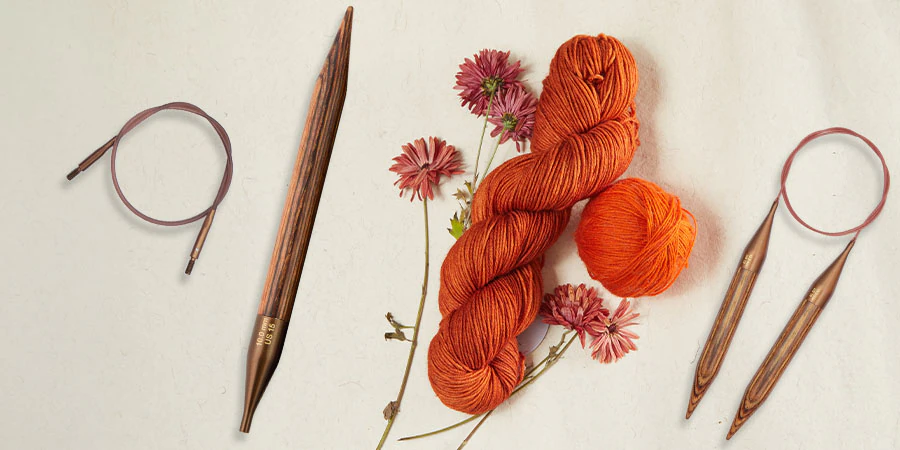
Circular needles consist of two needle tips connected by a flexible cable. They come in fixed lengths (from 23 cm to 150 cm) or as interchangeable sets where tips and cables are swapped to suit different projects. For knitting in the round, you cast on, join, and work continuously around the cable.
Circular needles can also be used for flat knitting, where you simply turn the work at the end of each row, making them one of the most versatile tools in any knitter's kit.
Best Projects for Circular Knitting Needles
- Hats, beanies, and toques (40 cm or 60 cm cables are ideal)
- Sweater bodies and yokes (80 cm or 100 cm for larger circumferences)
- Cowls and infinity scarves
- Shawls and blankets (flat knitting on longer cables)
- Socks and small items using the magic loop method
Advantages of Circular Knitting Needles
- Handles large stitch counts and large circumferences with ease
- Cable supports the weight of large projects = less wrist strain
- Magic loop technique allows one long circular to replace DPNs entirely
- Interchangeable circular sets offer exceptional versatility and value
- Fewer needle tips to manage compared to a set of DPNs
Challenges of Circular Knitting Needles
- Cable length must match or be shorter than the project circumference (except for magic loop)
- Cable memory (curling or kinking) can be an issue in cheaper sets
- Magic loop technique requires practice to learn the two-loop pull-through motion
Also Read: Interchangeable vs Fixed Circular Knitting Needles: Which Should You Choose?
DPN vs Circular Needles: Quick Comparison
|
Factor |
Double Pointed Needles |
Circular Needles |
|
Best for |
Small circumferences (socks, fingers) |
All circumferences; large projects |
|
Minimum circumference |
12–15 stitches |
Matches cable length (or magic loop) |
|
Beginner-friendly |
Moderate learning curve |
Easier to start with |
|
Wrist strain |
Low (short, light) |
Very low (cable supports weight) |
|
Versatility |
Specialized for small rounds |
Flat and circular knitting |
|
Travel-friendly |
Yes — compact sets |
Yes — especially interchangeable sets |
|
Laddering risk |
Yes — at needle joins |
No — unless magic loop joins |
Which Should You Choose? A Simple Decision Guide
Use double pointed needles when:
- Your project circumference is very small (under 20 cm)
- You're working sock toes, glove fingers, or I-cord
- You prefer the feel of short, maneuverable needles
- You don't yet own a circular set long enough for magic loop
Use circular knitting needles when:
- Your project circumference is medium to large (hats, sweaters, cowls)
- You want one needle type that covers both flat and circular knitting
- You're investing in an interchangeable set for long-term versatility
- You want to try two-at-a-time socks or magic loop for small items
Also Read: DPNs vs Magic Loop vs Mini Needles: The Ultimate Small Circular Knitting Guide
The Bottom Line
There is no universally 'better' knitting needle for knitting in the round. Many knitters keep both in their toolkit and switch freely depending on what they're making.
A good interchangeable circular knitting needle set is a good investment you can make if you are thinking of both back and forth and knitting in the round projects. A set of quality double-pointed needles rounds out your toolkit beautifully, with specialty tools for the smaller circumferences.
Whatever you choose, the craft remains the same: one stitch at a time, in an endless, satisfying round. With KnitPro Collection, explore tools that make crafting smoother.


