

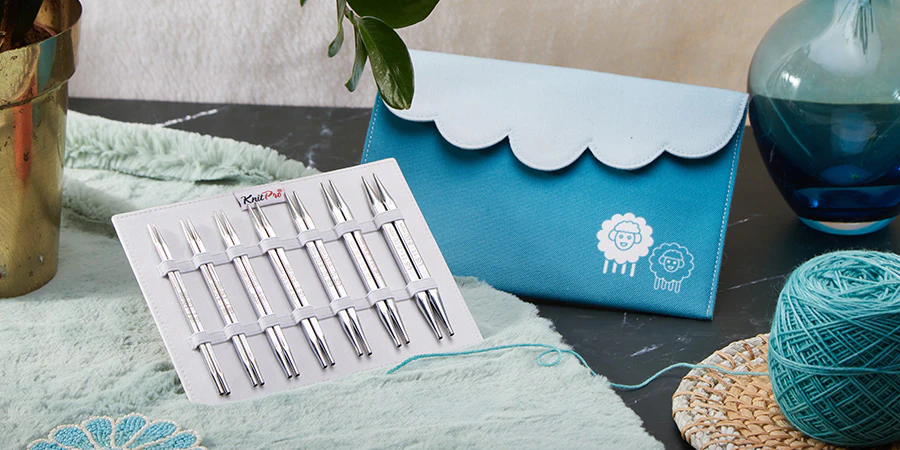
It’s cozy knitting season, which means winter sweaters, warm scarves, textured cardigans, and chunky accessories are calling. But before you cast on, there’s one important question to answer: How do you choose the right knitting needle size for the project? Getting the yarn weight to needle size pairing right is essential for achieving the correct gauge, stitch definition, drape, and fabric density. Winter knitting projects are focused on wearable, breathable designs.
One of the most common beginner mistakes is using the wrong knitting needle (both size and material) for the yarn, which can result in stitches that are too tight, too loose, uneven, or lacking the structure your winter project needs.
This yarn weight and knitting needle size pairing guide explains how to choose the right size for everything from cozy sweaters, cardigans, cowls, socks, and cable designs.
How Yarn Weight and Needle Size Work Together
Yarn weight describes the thickness of your yarn, while knitting needle size determines how you work with the yarn. As a general rule, lighter yarns work with smaller needles, while thicker yarns need larger needles. However, your pattern's recommended gauge and the fabric you want to create should always guide your final choice. What suits socks may not be a good fit for a cowl, and what works for a sweater may not suit a cardigan.
Also, many knitters face challenges with a particular yarn with wooden/ bamboo knitting needles that can be corrected with stainless steel, aluminium or even carbon fiber tools. Plus, cubic knitting needles are also a saviour when comfort is what’s giving you a challenge.
Also Read: Knitting Needle Sizes for Beginners: A No-Guesswork Guide
Use this quick knitting needle size guide as a starting point for your projects:
|
Yarn Weight |
Typical Needle Range |
Common Projects |
|
Lace |
1.5–3.25 mm |
Lace shawls, delicate accessories |
|
Fingering |
2.25–3.25 mm |
Socks, lightweight garments |
|
Sport |
3.25–3.75 mm |
Lightweight sweaters, accessories |
|
DK |
3.75–4.5 mm |
Sweaters, scarves, cowls |
|
Worsted |
4.5–5.5 mm |
Sweaters, hats, scarves |
|
Aran |
5–6.5 mm |
Winter sweaters, textured knits |
|
Bulky |
6.5–9 mm |
Chunky scarves, hats, blankets |
|
Super Bulky |
9–15 mm |
Cozy blankets, oversized accessories |
|
Jumbo |
15 mm+ |
Statement knits and extra-thick projects |
This yarn weight chart for knitting is a starting point, not a rulebook. Always check the pattern and yarn label before casting on. If your swatch does not match the required gauge, try adjusting needle size for gauge rather than changing the yarn immediately.
Choosing the Right Knitting Needle Size for Winter Yarn
When working on cold-season projects, yarn and needle pairing becomes especially important. A DK weight yarn may create a completely different fabric from a bulky yarn worked on large needles, even when both projects are designed to keep you warm. For sock knitting, a circular knitting needle and double-pointed knitting needles (DPNs) may have different gauge even though the needle size is the same. For cables and textures, there may be a mismatch between the pattern designer’s gauge and your personal tension.
For chunky winter knits, consider circular needles for bulky yarn or interchangeable needles that allow you to change sizes and cable lengths as your project develops. The cable handles the major weight of the project, leaving your hands free from the weight and stress. For textured stitches and cables, the right needle material can also provide the balance of grip and smoothness you prefer.
The goal isn't simply to use the largest needle possible for thick yarn. A yarn weight vs needle size mismatch can affect gauge, structure, stitch definition, and drape.
Explore the Symfonie 2 range or Ginger Cubics for warm wooden tools.
Also Read: Why the Same Size Knitting Needle Can Knit Differently Across Materials
Same Yarn, Different Needle Sizes: Why Your Project Matters
Once you understand the basics of yarn weight to needle size, choosing a winter project becomes much easier. Here’s something every knitter should know: the same yarn does not always require the same knitting needle size.
Yarn weight gives you a useful starting point, but it is the pattern's gauge, stitch structure, construction, and desired fabric that ultimately determine the needle size. That is why two sweaters made with the same DK-weight yarn can call for different needles, or why a cowl and a cardigan can have completely different needle recommendations.
So, begin by asking: “What needle size does my pattern require to achieve its intended gauge and fabric?”
Here are some examples:
Cardigans
Symfonie Plush uses DK-weight merino-silk yarn, while Coastal Cables uses DK-weight extrafine merino wool, and yet the knitting needle sizes differ. This is because of yarn fiber and the stitch pattern.
Scarves
For winter scarves, needle size influences both warmth and drape. A smaller needle can create a denser fabric with defined stitches, while a larger needle can produce a softer, more open fabric. Always follow the pattern gauge when choosing the best needle size for scarves.
Socks
Socks demonstrate the same principle. Terra fingering-weight merino-polyamide sock yarn appears in different sock patterns with different needle recommendations, depending on the required gauge and fabric.
Don’t choose knitting needles based on yarn weight alone. Check the winter project, pattern, knit a gauge swatch, and adjust your needle size to achieve the intended fabric. With KnitPro, explore knitting needles in a wide range of materials (wood, bamboo, stainless steel, carbon fiber and more) in single-pointed, double-pointed, fixed circulars, interchangeable circulars and sets.


